Monday, September 16, 2013

Keep Moving!


Calm Seas - now that's more like it!
After spending two nights at Bodega Bay, “Pacifico” seemed to be in a better mood and offered up calm seas for our early 6am departure.  We were greeted with light winds that continued through the day, including our traverse around Point Arena.  In order to take advantage of the good weather window, we continued motoring through the night. 


Arena Lighthouse
As we neared Cape Mendocino at 10:30 that evening, the seas became choppy.  This notorious cape is actually made up of several capes or points:  Cape Vizcaino, Point Delgada, Punta Gorda, Cape Mendocino, and False Cape - it took us about three hours to get around this large land mass jetting out towards the sea.  Strong wind and current, known as the “cape effect,” often create rough conditions for mariners.  Fortunately, we encountered only 22 knot winds and moderate chop, not considered extreme conditions for Cape Mendocino.
Sunset Welcomes the Night
Leonard and I shared helm watch through the night and slept off and on.  While Leonard was on watch we passed Eureka in the wee hours of the morning, suddenly the auto pilot dropped out and returned to “standby” mode (manual steering required).  The alarm hadn’t sounded so Leonard didn’t notice it until he looked at the chart plotter indicating that the boat was heading directly for land; “what’s going on? oops!”  He soon realized what had happened, got back on course, and re-engaged the auto pilot.  Then it was my turn to come on watch and I immediately noticed that a sailboat was directly ahead of our path about a mile out and approaching in the opposite direction.  Yes, it was time to take evasive action while Leonard caught up on some much needed sleep.  The dawn broke and gentle sea swells rolled under Got d’ Fever; it was the start of a new day.  Once again the seas were calm and we saw several whales making their north-south ocean voyage. 
Coast Guard on Patrol
Commercial Shrimping
Two fishing vessels could be seen in the distance trawling for their catch.  Over the radio we could hear the Coast Guard asking the captain of each fishing vessel what type of fish they were hauling.  Soon the Coast Guard Cutter headed our way and we too were contacted by radio, “what is your purpose and destination” they asked, “and when were you last boarded?”  We didn’t mind the questions; it’s nice to know that the Coast Guard boys are around!  
Commercial Fishing
We continued our journey northward, bypassing Crescent City and the historic Saint George Reef Lighthouse.  We reached Brookings, Oregon around 3pm and after a quick pit-stop for fuel, we were off again for another overnighter - “keep moving when the weather is good!” 
Saint George Lighthouse

Saturday, September 14, 2013

Changing Course


Boaters are often flexible regarding their choice of destinations and play things by ear depending on their wish list and or changing life styles.  For us, “changing course” has a double meaning.  After taking another trip by car to Seattle, we decided that it’s time to let go of a house we no longer need.  Yes, we are putting our home on the market around the first of March and have begun the process of completing projects in preparation for this change.  We also decided to motor the boat north to Seattle rather than make frequent car trips back home to work on the house.  Motoring up the West Coast this time of year, however, can be very challenging.  We left San Francisco on September 13th heading for Bodega Bay just north of the notorious Point Reyes.  We encountered winds ranging from 15 knots to 35 knots which we have negotiated in the past, but the waves were close together and steep, more so than anticipated.  


ZigZag Path (right dark blue line)
It was the first time we’ve had to travel in a zigzag course to safely negotiate the steep waves and we were still being knocked around.  Water was splashing up over the pilothouse windows so frequently that water seeped through the pilothouse doors.  It felt as if Got d' Fever was falling down the front side of the 8-9 foot steep sea cliffs.  One wave threw me across the room and I fell on my “A Double S” – good thing I have some padding!  Java had the advantage with this one due to her low center of gravity and four legs.  What was to be a 5-hour trip turned into a 6-hour trip due to our zigzag course; we made it into Bodega Bay with the wind still howling and found a side-tie for the night.  We were glad to be past one of the worst Points on the West Coast.  Weather for the next couple of days should be much better enabling us to make further progress northward.

Monday, September 2, 2013

The Palace of Fine Arts


Colonnades and Rotunda - Palace of Fine arts
Over Labor Day Weekend we visited the Palace of Fine arts located in the Marina District of San Francisco.  This monumental structure was built for the 1915 Panama-Pacific Exposition to display works of art.  Built next to a small lagoon, the Palace is composed of colonnades and a central rotunda. 


Colonnades along the Lagoon
The lagoon fronting the Palace of Fine Arts was a feature of San Francisco’s early landscape, part of a slough on a tidal wetland.  At the time of the Panama-Pacific International Exposition this slough, cut off from the tidal flow, had become a freshwater lake reduced to the size of a city block.  When Bernard Maybeck was appointed to design the Palace of Fine Arts, Maybeck incorporated the natural beauty of the site into his design, echoing that found in classical European settings. 

The Palace was so beloved that a Palace Preservation League, founded by Phoebe-Apperson Hearst, was formed while the fair was still in progress.  Most of the buildings were demolished after the Exposition, but the Palace had been saved thanks to the preservation league.  Originally intended to only stand for the duration of the Exhibition, the colonnades and rotunda were made from wood covered with staff, a mixture of plaster and burlap-type fiber.  
Beautiful Detail
By the 1950’s the structures had dramatically deteriorated.  In 1959 philanthropist Walter Johnson spearheaded an effort to raise preservation funds and donated four million dollars.  The structures were stripped to their foundations and a permanent version of Maybeck’s design was reconstructed in steel and concrete with details cast from the original.  
A Peaceful, Inspiring Setting

The only changes were the absence of the murals in the dome, two end pylons of the colonnades, and the original ornamentation of the exhibit hall.  Exterior lighting was added in the late 1980’s for the rotunda and colonnades, creating a lovely ambiance at night.  San Francisco once again rallied to save its Palace in 2003, when the Maybeck Foundation partnered with the City of San Francisco to raise 21 million dollars for significant seismic upgrades, which were completed in 2009.  
The Rotunda
The Rotunda
A
n awe inspiring classic beauty and lovely retreat for city dwellers, the Palace of Fine Arts is indeed worth preserving.  In addition to hosting art exhibitions, theatre productions, and special events, it remains a popular attraction for tourists and locals alike. 


Sunday, September 1, 2013

Presidio of San Francisco


Golden Gate seen from The Presidio
 
Today we visited the Presidio of San Francisco.  The Presidio (originally, El Presidio Real de San Francisco (the Royal Fortress of Saint Francis) is a 1,491 acre public park and former military base located on property at the southern end of the Golden Gate Bridge.  The Presidio has a military history dating back to 1776 when a 63-man expedition of Spanish soldiers, priests, and settlers arrived to establish a presidio under the authority of Spain in answer to English and Russian interests.  Father Junipero Serra established a mission nearby, calling it San Francisco de Asis, later known as Mission Dolores.  Authorities in Spain were not happy when they heard that English Captain George Vancouver had visited the Presidio in 1792, fearful that he would divulge crucial information about the Presidio. 


Golden Gate and Battery Emplacement (left)
The Presidio later passed to Mexico following their independence in 1821 and was subsequently seized by the United States Military in 1846 at the start of the Mexican-American War.  This U.S military post officially opened in 1848 and became home to numerous Army headquarters.  Several famous U.S. generals such as William Sherman, George Henry Thomas, and John Pershing made their home here.  
WWII Battery Emplacement - Presidio of San Francisco
Fort Winfield Scott
The Park includes the military post of Fort Winfield Scott, completed in 1915, which defended the Bay Area for 40 years.  Most of the buildings were constructed in the Spanish Colonial or Mission Rival Style.  The fort included an infirmary, barracks, parade grounds, a stockade, workshops, storehouses, and recreational facilities.  There are 768 historic buildings and structures that remain in the Park plus huge coastal batteries overlooking the ocean.  
Fort Winfield Scott and the Golden Gate
Officers Row - Fort Winfield Scott
The Presidio acted as the nerve center for Army operations during WWII in defense of Western United States.  The Letterman Hospital was one of the Army’s busiest medical centers with a peak load of 72,000 patients in one year.  The complex now serves as the Thoreau Center for Sustainability, housing non-profit organizations.  As part of a 1989 military reduction program, Congress voted to end the Presidio’s status as an active military installation.  On October 1, 1994, it was transferred to the National Park Service ending 219 years of military use.  The park is characterized by many wooded areas, hills, and scenic vistas overlooking the Golden Gate Bridge, San Francisco Bay, and the Pacific Ocean.  Living quarters once occupied by officers and service men are leased as homes while other buildings are used for museums, park services, private schools, business organizations, and special events.


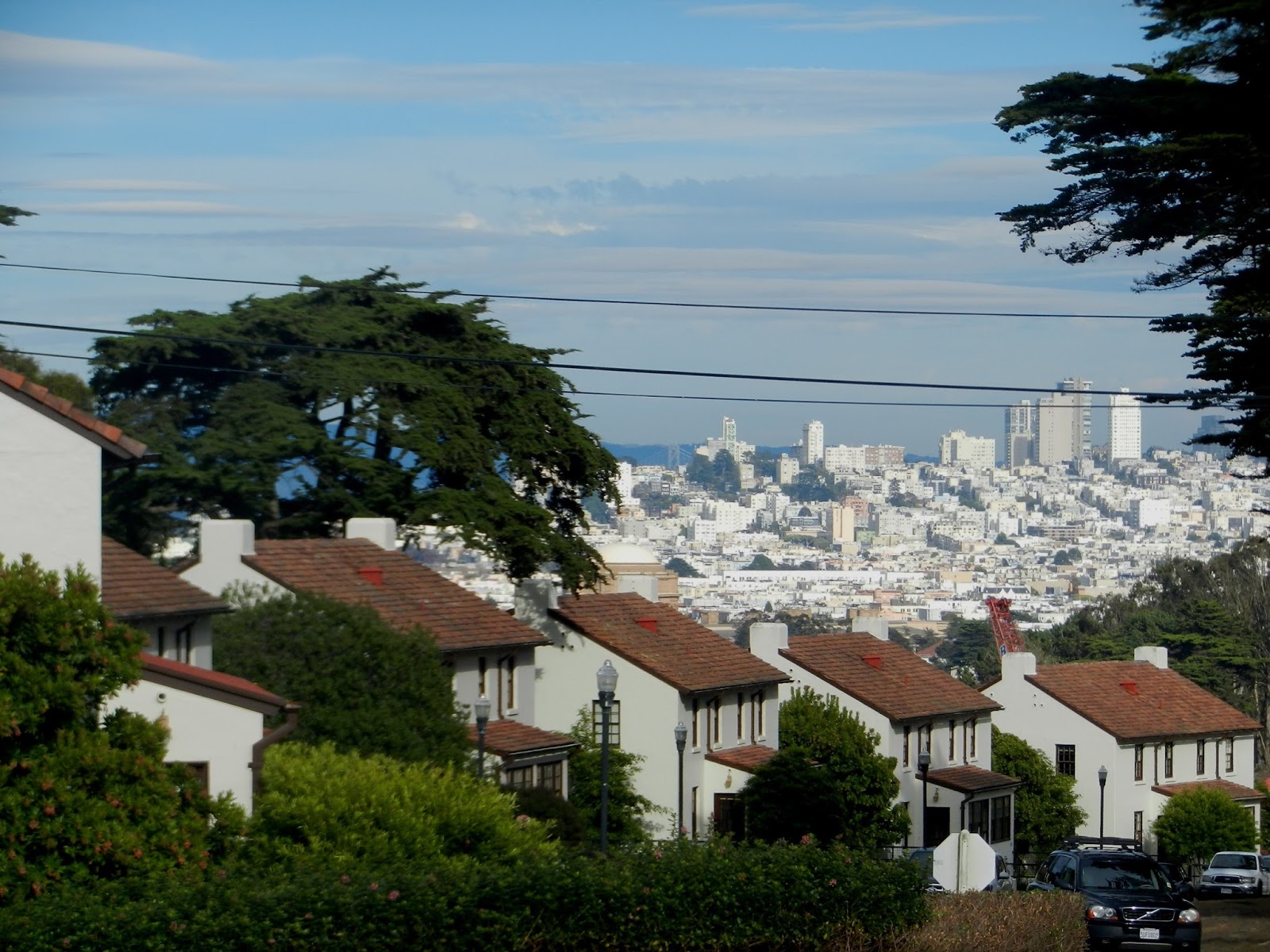
Presidio Housing overlooking the City

The Letterman Hospital - old main building

Saturday, August 31, 2013

The Hetairos


Two-Masted Hetairos - Woodwork being Refinished
 
Our latest haulout is behind us and we now look back on the unique and fun experience of living in a boat yard and the opportunity to see some very special vessels including the sailing ship, Hetairos.  While we were at the yard, this 215 foot sailing vessel was moored at the docks, attracting lots of attention.  The owner had flown a work crew of eight from the island of Antigua in the West Indies just to refinish all of the woodwork – cap rails, side panels, and two cabins above decks, no doubt requiring several months of work.  The Hetairos is known for her participation in the Transatlantic Superyacht Regatta & Maxi Yacht Cup in 2011, a 3,000 mile crossing ending in the British Virgin Islands at Virgin Gorda.  Her passage time of less than 9 days pushed the boundary of design and innovation.  She had averaged 15.12 knots with a recorded top speed of 25.7 knots, an impressive first-place showing. 


Hetairos Under Sail
The ship made of carbon fiber was designed by naval architect Erik Wassen; he is responsible for her lines, styling, sail plan, deck plan, sail handling systems and deck gear development, as well as weight calculations - construction began in 2006 at Baltic Yachts in Finland.  
A Beautiful Interior despite the challenges of a Carbon Fiber Build
There are three unique under-deck furlers for the yacht, and even the glass for the deck-houses was specially made for the project.  Rhoades Young Design created the interior; the company had also worked on the previous Hetairos (now for sale) and was familiar with the owner’s attention to detail.  With a carbon build, the interior is so integrated that care had to be taken to match the strict weight requirements with a technical approach as well as creating an artistic beauty unique to her alone.  Everyone at the KKMI Boat Yard seemed to enjoy her company and stopped by each day to see the spit and polish in progress on this two-masted beauty.  
Boom Strapped and Ready to be Hoisted
Then one day a most unfortunate incident took place – someone accidentally activated a hydraulic system that crunched the forward carbon fiber boom, which rested on a chock.  Fiberglass covering the carbon fiber sustained a large crack and now needed to be repaired!  News of the incident spread around the yard like wild fire, I grabbed my camera to get some shots of this huge boom that’s larger than most sailboats and that was soon to be hoisted off the Hetairos.  
The Huge Boom Passing Over the Docks
Lots of Helping Hands
A crane from the KKMI boat yard reached over the docks and hooked onto the massive boom secured by straps then swung it over the docks and boardwalk into the boat yard, a technical feat in itself.  
It's Hard to Grasp the Size of that Boom!
The boom was carefully lowered onto movable padded chocks and rolled into a large work shop for repairs.  The ordeal was accomplished with great care and forethought and was an amazing process to witness.  
Cracked Fiberglass seen on the Boom
On its way to the Repair Shop
No, we never discovered who owns Hetairos, but can’t imagine they’re too happy about the unfortunate incident.  The good news is that the polished finish work looks fantastic!

Friday, August 30, 2013

Daily Life in a Boat Yard


Access Ladder while in the Boat Yard
 
As mentioned in the previous blog posting, we were allowed to live aboard our boat at KKMI boat yard while we had some routine maintenance completed.  Living in a boat yard has its advantages as well as some inconveniences.  Climbing up and down a ladder to access your boat takes some care, especially when you’re holding a bucket full of dishes to be washed in the yard’s bathroom sink.  Sink drains on boats are open to the outside so I didn’t want the workers below to receive an unwanted shower while applying bottom paint!  Of course using the boat’s toilet wasn’t an issue since there’s a holding tank, but Java needed regular trips to the flower bed to do her business.  


New Rudder Zincs
The advantages, however, outweighed the inconveniences.  We could work on the boat and take care of projects that are best done when the boat is out of the water such as scraping off barnacles, changing the zincs, cleaning and waxing along the waterline, and cleaning under the swim step and changing out rusting screws. 
New Bow Thruster Zinc(s)
New Prop Zinc(s)
We also sprayed the propellers with "Barnacle Block" which helps prevent barnacle growth.  Another project involved laying out the anchor chain so we could clean out the anchor locker.  While the chain was laid out on the ground, we sprayed the links with WD40 and added new markers for every 30 feet of chain.  
"Barnacle Block" sprayed on Propellers
Laying out the Anchor Chain
We worked really hard each day from 7am to 7pm and much appreciated the on-site shower rooms which we used on a regular basis.  The yard even has an on-site marine supply store; if we purchased an item that didn’t fit, it was a quick visit to the shop for the correct part.  
Cleaning the Air Filters - Washing Station
Another convenience was the ability to clean out the air filters for the engines, a messy job that releases dirt and oil into the environment if not contained.  Our assigned project manager, Jock, was kind enough to offer the use of their "washing station" which includes an environmentally friendly system to capture dirt and oil.  
Washing Station - oil containment system
Each customer of the yard is assigned a project manager to coordinate all the various jobs for each particular boat; our assigned manager, Jock, did a wonderful job keeping our projects moving along in a timely manner.  
Bottom Painting
In addition to sanding and applying new bottom paint, yard workers also installed a divider in the anchor locker in order to stow our second back-up anchor chain and rode.  We also had additional sound-proofing installed in the engine room and shrouds installed around the shaft seals.  
Anchor Locker with New Divider
The final project completed was the addition of a barrel-bolt latch for the sliding hatch door which leads to the boat deck above – no more releasing or rattling in heavy seas!  We were very pleased with all the work completed by KKMI and enjoyed working with the knowledgeable and talented staff.  Living in the boat yard also proved to be very entertaining with so many different types of boats and jobs in progress – a 215 foot sailboat from Europe was the center of attention, but that’s another story yet to be told.  After seven days in the boat yard, we “splashed” on August 28th and spent the day cleaning the boat inside and out from all of the dust that had collected from the boat yard.  As a parting gift, Jock had given us a bottle of wine with a KKMI label; he said it would help relieve the sticker shock when we saw the invoice, ha.  We motored back to our slip at Brisbane Marina the following day and caught up on some much needed sleep!  The next day we finally worked up our nerve to look at the invoice and were pleased to discover it was what we had expected - a reasonable cost for the work done, thanks KKMI.

Time to Celebrate

Friday, August 23, 2013

Hold Your Breath Haulout!

Walking the boat forward for Haulout


A Careful Helping Hand
No matter how many times we haul out the boat, it’s always a nerve-racking experience.  We can’t help but wonder if the straps are secured and in the right position, if the sides of the boat will be protected, and will the boat be properly supported when “on the hard?”  On the morning of August 22nd, we motored to the lift at KKMI Boat Yard, located in Richmond Yacht Harbor.  We were third in line for our haulout.  The lift attendants asked us about the boat’s weight and bottom configuration; we showed them markings on the side of our boat which indicated the position for straps.  The attendants walked the boat forward into a narrow space, positioning the boat over the straps draped low in the water. 


And Up She Goes
Once the slings were in position, Got d’ Fever was hoisted slowly out of the water - 60,000 pounds suspended by only two straps!  With the boat secure in her sling, the enormous lift drove to the yard where her underside was power washed and cleaned.  
And UP
Ready for an Underbelly Wash
Next she was driven to a more permanent spot for bottom painting and other maintenance work.  

Backing Into Our Work Space
Placing Wood Supports under the Keel
Now comes the really scary part - large wood blocks are positioned under the boat on which she will sit; the boat is lowered onto these supports while iron boat-stands are added to each side of the boat for lateral support.  When all the supports are in place, the straps are released and we hold our breath!  Talented yard employees know exactly what they are doing and make it look so easy but we are always impressed.  
Adding Iron Boat-Stands
Our project manager was on site within the hour and shortly thereafter the assigned workers were prepping and sanding Got d’ Fever for a new coat of bottom paint.  In addition to work being done by the yard, we had planned to take care of some maintenance items on our own.  Most yards don’t allow boaters to live on their boat while it’s in the yard, KKMI is a rare exception.  Stay tuned to hear about our day-to-day living in a boat yard!

Releasing the Straps - Hold Your Breath!