Wednesday, July 18, 2012

Small Town, Big Beach


Half Moon Bay
Inspiring View at Half Moon Bay
The small town of Princeton along the shore in Half Moon Bay is a wonderful stop for cruisers.  This attractive village is peaceful and quiet (except for the foghorn) and has excellent restaurants and cafes within easy walking distance of the marina in Pillar Point Harbor.  The town even has a lovely glass-roofed shopping mall and a café/bakery offering delectable pastries, pies, and other sweets.  We also discovered that Half Moon Bay has some of the most beautiful beaches along the California coast.  We were fortunate to have wonderful weather during our two-day stay – warm temperatures and a blue sky, perfect for our bike ride on the Pacific Coast Trail that runs just above the beach.  Brown Pelicans skirted the cliffs, breaking waves crashed into shore, and people walked on the sandy beach; it was one of those incredibly inspiring scenes.  Yes, one of those “I could die happy here places.”  We departed the next morning (July 18th) with calm seas and clear weather, giving us great views of the coastline.  Java stretched out by the cabin door soaking up the warm sun while enjoying the gentle six-hour ride to Santa Cruz, next stop on our southbound journey.

Sandstone Cliffs at Half Moon Bay
Pacific Coast Trail and Bike Path
Perfect Day for a Bike Ride
Pillar Point Harbor 
Delectable Sweets at Princeton Village
Cruising the California Coastline
Java Enjoying The Ride and Warm Sun

Monday, July 16, 2012

Goodbye San Francisco


Alcatraz Island
Alcatraz Island
Alcatraz Island
When the time came to leave San Francisco, we departed with mixed emotions; it’s such a wonderful city.  We also hated to say goodbye to our new found friends in Alameda, Judy and Michael.  They were our neighbors at the Marina Village Harbor and gave us such a nice, warm welcome.  The four of us seemed to hit it off, sharing boating stories and flying stories; yes, Leonard found another pilot!  We hope to meet up with Judy and Michael in Mexico when they arrive this coming winter aboard their sailboat, Milagro (Spanish for Magic).  They have cruised to Mexico in years past so they had lots of helpful information to share with us.  While in Alameda, we rode our bikes through town where we saw numerous well-kept Victorian homes along streets lined with beautiful large oak trees.  The community struck us as one of the most ethnically diverse that we have found.  We also biked along Alameda Beach, a popular spot for sail boarders and kite boarders.  As we cruised out of the Bay Area along the San Francisco waterfront, we thought of all the great fun we had experienced here.  Even though we didn’t get to tour the Island of Alcatraz, we did boat past the Island for some up close views of the many historic buildings.  Alcatraz, known as “The Rock,” was developed with facilities for a lighthouse, a military fortification, a military prison (1868) and as a federal prison from 1933 until 1963.  After passing Alcatraz, we cruised under the Golden Gate Bridge, heading out to sea once again.  The sea greeted us with four foot chop, making it a lumpy ride all the way to Pillar Point Harbor in Half Moon Bay.

"I Left My Heart in San Francisco"
Departing the Golden Gate

Saturday, July 14, 2012

The Floating White House

The Potomac

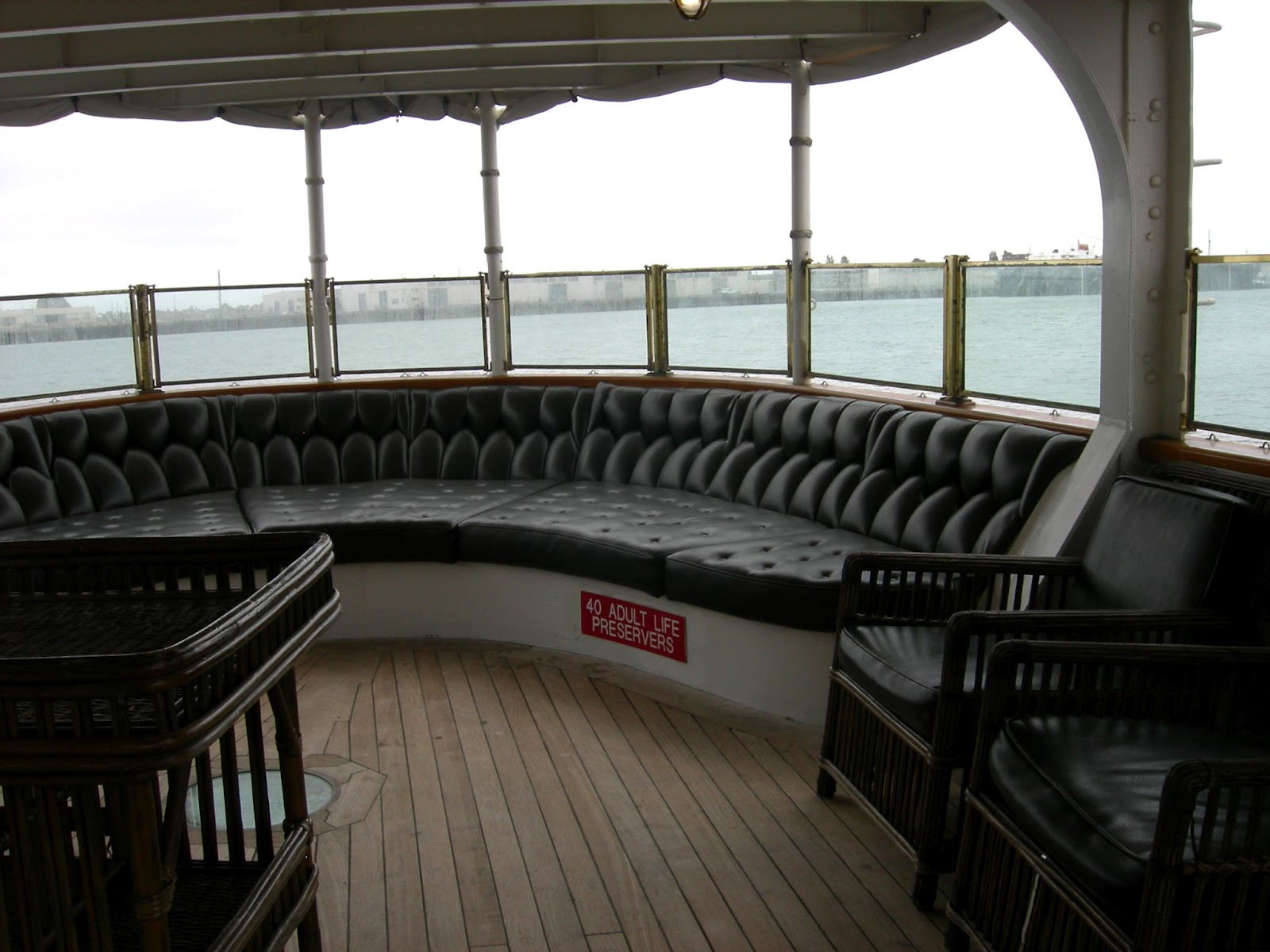
We took our dinghy across the Inner Harbor Channel one day to tour FDR’s yacht, the Potomac, moored next to the Oakland ferry terminal.  The USS Potomac was built in 1934 as the Coast Guard cutter Electra.  In 1936 the ship was commissioned as a U.S. Navy vessel and renamed the USS Potomac to serve as Franklin Delano Roosevelt’s Presidential Yacht.  The Potomac played a major role in world affairs but after FDR’s death, she began her sad decline and changed ownership numerous times.  In 1980 she was seized in San Francisco as a front for drug smuggling and impounded at Treasure Island in San Francisco Bay where she sank, her hull had been pierced.  The vessel was raised only to be dumped in the East Bay Estuary.  A week away from being sold as scrap, the ship was rescued by the Port of Oakland and the process of restoration began with the help of Government monies from President Reagan.  The structure of the vessel proved to be sound, and the interior was restored and furnished to match the original as closely as possible.  Five million dollars were spent over a 12-year period to restore the 165 foot vessel as a memorial to the president who authored the New Deal and led the United States through the Great Depression and World War II years.  The Potomac opened to the public in 1995 offering dock-side guided tours and cruises.
Roosevelt loved the sea.  He spent most of his summer holidays with his parents off the coast of Maine where he learned to sail; at first in small sailboats which he cruised amongst the neighboring islands.  As a young man he acquired a 37-foot schooner, the Half Moon, which he sailed along the New England coast.  Regrettably, he had to part with the yacht in 1921 when he was affected by polio.  After an intensive swimming program and strengthening exercises, he resumed sailing and chartered a small yawl, the Amberjack II, which he sailed with his sons until the summer of 1933.  After his election as President in 1932, he ordered the re-fitting of the Electra and re-named it the USS Potomac.  Roosevelt’s tastes were simple, preferring the look and feel of a navy ship rather than a pretentious yacht.  Since Roosevelt didn’t like traveling by plane he often traveled by train or aboard his presidential yacht.  He spent so much time on the USS Potomac that it was nicknamed “the Floating White House.”
Fantail of the Potomac
Relaxing on the Fantail as did FDR
The Dining Room
Ship's Elevator for FDR

Thursday, July 12, 2012

Jack London’s Oakland


City of Oakland seen across the channel from Alameda
Securing the Dinghy at Jack London Square - Oakland
Jack London Cabin
From Marina Village Yacht Harbor in Alameda, we took our dinghy across the Inner Harbor Channel and visited Jack London Square along Oakland’s waterfront.  Jack London (1876-1916) was born in San Francisco and much of his youth was spent in Oakland on the waterfront.  Jack became the most popular and highest paid author of his time.  He is best remembered as the author of Call of the Wild, White Fang, and The Sea Wolf.  London was also an advocate of unionization and socialism and dealt with these topics in his novel The Iron Heel and in his non-fiction expose’ The People of the Abyss.  The “First and Last Chance Saloon” along Oakland’s waterfront was frequented by Jack London and still stands in its original location.  We paid a visit to this historic saloon where Jack studied as a schoolboy and where he later wrote notes for The Sea Wolf and Call of the Wild.  The same tables where he sat are still in the saloon along with the original stove, bar & rail, clock, music box, movie machine, and other items.  The dimly lit saloon uses the original gas lights and the stove was used as the only source of heat as late as 1989.  The saloon was built in 1880 from timbers of an old whaling ship and opened in 1883 by Johnny Heinold, a historic figure in his own right.  During the 1920’s, the ferry that ran between Alameda and Oakland stopped next to Heinold’s Saloon.  Since Alameda was a dry city at the time, this bar was truly a commuter’s first and last chance for a refreshment.  Other notable figures that visited the First and Last Chance Saloon included President William Howard Taft and Robert Louis Stevenson, who spent time here waiting for his ship to be outfitted for his final cruise to Samoa.  While enjoying our drinks at this saloon from the past, we couldn’t help but notice the sunken floor and extremely uneven bar.  When the great San Francisco earthquake struck in 1906, the pilings underneath the saloon settled in the mud.  We also visited Jack London’s Cabin located near the Saloon, or should I say half the cabin.  When London’s actual cabin was found from his trip to the Yukon Gold Rush, the City of Oakland and Canada both wanted it – the solution, cut it in half!  The Oakland cabin is a recreation from half of the original materials and stands in stark contrast to the modern skyline of Oakland.
"First and Last Chance Saloon"
Sloped Bar due to sunken floor in the Saloon
Window Near Street Level!
Historic Photos of Jack London in Saloon
Original Furnishings in Saloon (note uneven floor)

Tuesday, July 10, 2012

What’s He Doing?


Alameda/Oakland (Bay Bridge & San Fran in background)
Busy Shipping Port in Oakland
We motored east across the Bay from San Francisco and up the Inner Harbor Channel that separates Alameda (an island) from the City of Oakland.  The Channel is a major transportation hub and shipping port for the Bay Area and is the fifth busiest Port in the United States.  We passed by hundreds of shipping containers and numerous gantry cranes that line the Channel leading to Oakland and Alameda.  Once past the main Port operations, pleasure boaters head for one of several marinas located on both sides of the Channel.  As we neared our destination, we noticed a cargo ship up ahead being maneuvered by two tugs – pulling and pushing it to shore, or so we thought.  We approached slowly, trying to determine what exactly was going on.  Two other tugs on the opposite side of the cargo vessel could be seen on our AIS navigation screen.  We were contemplating what to do when a marine police boat sped by and went around the cargo ship.  “I guess that’s our queue, let’s follow his lead and quickly get around that cargo ship,”  I said.  When we reached the front end of the ship, we could see the other two tug boats – “oh my Gosh! They are spinning the ship around, yaw!”  We passed by with the ship’s bow looming above us.  As we looked back, the cargo ship was across the Channel, temporarily blocking all marine traffic.  “Ok, that was fun, now how do we find the right marina?”  Amongst a maze of marinas, we located the “Marina Village Yacht Harbor” at Alameda.  After pulling into the pumpout station and taking care of some unfinished business, we went to our reserved moorage end-tie at the marina located next to some cute floating homes.

Approaching a Cargo Ship and Tugs at Work
Skirting Around the Cargo Ship
Oh, Hello!
We Made It! (rail on our boat, lower left)
Looking Back - Channel Blocked
Our Reserved Moorage next to the red houseboat - Alameda

Monday, July 9, 2012

Boats, Bicycles, and Cars


WWII Submarine Pampanito (Liberty Ship in background)
Submarine Pampanito
Forward Torpedo Room
During our stay in San Francisco, we took a self-guided tour of the Balao Class submarine Pampanito moored at Fisherman’s Wharf.  The Pampanito made six patrols in the Pacific during World War II, at which time she sank six Japanese ships and damaged four others.  She served as a Naval Reserve Training ship from 1960 to 1971 and is now a National Historic landmark, preserved as a memorial and museum ship.  Movie buffs may be interested to know that Pampanito was used in the 1995 film “Down Periscope.”  Submarines traditionally had two periscopes, a navigation or observation periscope, and a targeting or commander’s periscope.  Navies originally mounted these periscopes in the conning tower, one forward of the other in the narrow hulls of diesel-electric submarines.  Three main components make up the structure of a WWII submarine:  the inner hull, the outer hull, and the superstructure.  The inner hull or pressure hull is a long cylinder with torpedo tubes at each end and houses the crew and machinery.  The outer hull forms the skin upon which the submarine floats when on the surface.  The superstructure sits on top of the hulls above the waterline and is cut with holes called limber holes, which allow free-flooding when the submarine dives.  After touring the submarine, we ate lunch and then headed to another popular tourist stop.  Since we were on our bicycles for the day, we decided to ride our bikes down Lombard Street located southwest of Fisherman’s Wharf.  Lombard Street has eight sharp hair-pin turns along a single block between Hyde and Jones Streets.  Although the steepest street in town is Filbert, and Vermont Street is slightly curvier than Lombard, the latter is best known for its beauty and has been featured in numerous movies.  In the 1920’s a property owner in the area suggested the creation of switchbacks to better negotiate the hill’s natural grade of 27 percent which was too steep for most vehicles.  The red-brick paved switchbacks are lined with beautiful flowers, lovely homes, and artistic landscaping making Lombard one of the most photographed streets in San Francisco.  We pushed our bikes for two blocks up the steep hill from the west side of Lombard and waited our turn to ride down the crooked section of road.  A long line of cars were also waiting at the top of the hill.  We could hear tires screeching and smell brake pads burning as more cars drove up the hill to get in line.  The intersection is so congested with tourists that a traffic cop is on site directing pedestrians, cars, and bicyclists all day long.  We walked our bikes to the “start line” and slowly headed down the switchbacks with our brakes pressed on the entire way – I’d rather burn up bicycle brakes than skin up knees, arms, or legs!  After we finished the switchbacks, the street continued its steep pitch for another two blocks.  Whew! We safely made it down one of the steepest streets in San Francisco!
Lombard Street between Hyde & Jones 
Negotiating Steep Lombard Street
Cars and Pedestrians at Lombard Street
Traffic Down Lombard Street

Sunday, July 8, 2012

Out on the Town


Cafe Tiramisu - Belden Place
Lorena and Cousin Randy
We had a great time out on the town with Cousin Randy and Seb, starting with drinks at "The Slanted Door" in the lovely Ferry Terminal building, which includes a number of interesting shops, restaurants, and markets.  Then it was off to the swanky Kokkari Estiatorio bar where we hobnobbed with some local TV personalities that happened to be there.  We were excited about what was yet to come.  Randy and Seb had told us that they had a surprise dinner venue in store for us so we followed their lead.  We walked to a narrow alleyway (Belden Place) where several European style restaurants are located, including two French restaurants, an Italian restaurant, and a Mediterranean restaurant.  We were seated outside at tables set with linen tablecloths and enjoyed a wonderful Italian meal at Café Tiramisu.  It is indeed a lovely setting, lit with tea lights strung across the alley and lights from skyscrapers create a nice backdrop.  What a pleasant surprise and a unique place to enjoy an evening!  After dinner, they walked with us part way back to the boat, stopping at the elegant Palace Hotel.  We went inside to see the beautiful ballroom and glass ceiling, which was shot in the movie “The Game.”  After a wonderful evening, we arrived back at the boat around 11:30pm.  The next day, Leonard and I rode our bikes to the Ferry Terminal to check out the Saturday Farmers’ Market that Randy had told us about.  There were throngs of people and bicycles everywhere.  Colorful tents were set up around the Ferry Terminal and along the waterfront where customers were busy buying fresh fruits and vegetables as well as artisan breads and cheeses.  Leonard was like a kid in a candy shop.  Before we knew it, we had two bags filled with fruit, cheese, and vegetables to take back to the boat.  Leonard tied a bag to each handlebar of his bicycle and made it back to the boat all in one piece – yes both Leonard and the produce.

The Palace Hotel
Ferry Terminal and Saturday Farmers' Market
Ferry Terminal Building
Saturday Farmers' Market
Leonard and his Bags of Produce