Monday, January 14, 2013

Spare Parts, You Can’t Have Too Many!


Drain Hole at Bottom of Sea Strainer
Sheered Off Drain Plug
Bag of New Sea Strainer Plugs and Sheered Off Top
Sea Strainer with New Drain Plug
While anchored in Bahia de Chamela, Leonard decided to take care of some routine boat maintenance.  He went in the engine room to clean out the sea strainer basket for the starboard engine, a simple procedure of removing the drain plug from the sea strainer and lifting out the basket to be cleaned.  The simple task, however, did not go as planned.  After rustling around below decks, he appeared with one of those expressions on his face - “why me? I don’t believe it!”  When he backed out the drain plug on the sea strainer it had sheared off, leaving a piece inside the drain opening.  Not a good thing he explained – a piece of neoprene plug left in the drain opening meant water would leak out which could potentially introduce air into the cooling water when the engine ran!  Fortunately, he had a bag of spare plugs for the sea strainers - something we never imagined would be needed.  It certainly drove home the lesson that you can’t have too many spare parts, even the most inconspicuous and smallest of parts!  Of course he had to get the broken piece out first.  The piece was lodged flush with the surface of the drain hole with nothing to grab on to.  With a sharp pointed knife, he pierced the piece of neoprene plug and was able to unscrew it far enough to grab it with a pair of pliers.  With the sea strainer cleaned and the new plug installed, we were back in business.  Leonard’s next project was to dive the bottom of the boat and check out the zincs and prop shafts.  After setting up the hooka-hose and air tank, he dove under the boat while I checked his tank gage and listened to make sure he was still sucking air!  After a few minutes, he bubbled up to the surface and reported that the zincs were in decent shape, not needing to be replaced at this time.  The huge amount of growth on the bottom of the boat, however, was troublesome.  HHAn inordinate amount of algae, seaweed, and barnacles had attached themselves to the props and prop shafts, no doubt affecting our speed.  I guess it’s not too surprising considering that we’ve been cruising in very warm water during the last several months; not nearly a concern in the Pacific Northwest!  Leonard went back under the boat with a scrub pad and went to work cleaning the props.  There was so much growth to remove that the intense scrubbing literally disintegrated the pad!  To clean the shafts meant using up most of the air in the tank.  Leonard decided it would be wise to leave air in the tank in case of a real emergency, like untangling fishing net or other debris that could get wrapped around the prop.  Cleaning the shafts would have to wait until a later date.


Top Lid on Sea Strainer
Air Tank and Hooka-Hose
Leonard Diving the Boat

Sunday, January 13, 2013

Bahia Chamela on the Costalegre Coast


Beautiful Bahia de Chamela
Sea Stacks at Bahia de Chamela
Birds Among the Cactus
 

Our Dinghy Anchored at a Secluded Beach
Booby
Booby
After a somewhat sleepless night of toss and roll on the ocean swell at Yelapa, we departed in the morning at 5:30am to take advantage of the calm seas to round Cape Currents or Cabo Corrientes.  True to its name, we did experience some strong current around the point where the coastline turns and heads in a southeast direction.  This beautiful remote coastline known as the Costalegre Coast extends to Manzanillo and includes about a dozen beautiful bays easily reached in short day hops once you arrive at the first bay of Bahia Chamela.  After twelve hours of motoring, we reached the scenic bay of Chamela backed by the beautiful Sierra Madra del Sur and anchored off a nice sandy beach near the village of Perula.  We spent time here exploring the area and its islands which are part of the national park system.  From the dinghy we could see numerous species of birds perched in rock outcroppings, hiding in the trees, and atop the cactus.  As we explored further, we came upon a small, secluded white sandy beach tucked between some islets.  What a perfect place to go snorkeling - the sand so white, the water a beautiful turquoise, and the rocky islets yielded interesting and colorful fish.  We anchored the dinghy just off the beach and had a wonderful time peering at a variety of fish in their water world, deep below our own.  After snorkeling we swam ashore and walked through the soft sand, sharing the beach with an Egret and several Boobies.  I had to get some pictures of these unique birds so I swam back to the dinghy to get the camera, placed it inside a “dry bag,” and swam back to shore holding the bag over my head as a precaution, swimming with one arm, whew!  After a great time at this private little beach, we motored across the bay and along the shoreline where we found a lovely private resort with a dozen casas sporting red-tiled roofs surrounded by huge palm trees.  It was a fun day, certainly better than the previous day spent on boat maintenance, which turned out to be one of those “oh my, I can’t believe it” days.  More details to follow.

A Lovely Secluded Beach
Lorena Snorkeling
Egret

Friday, January 11, 2013

Native Village of Yelapa


Village of Yelapa
Inviting Beach at Yelapa
Heading for a Restaurant in Town
Meeting our Friendly Waiter
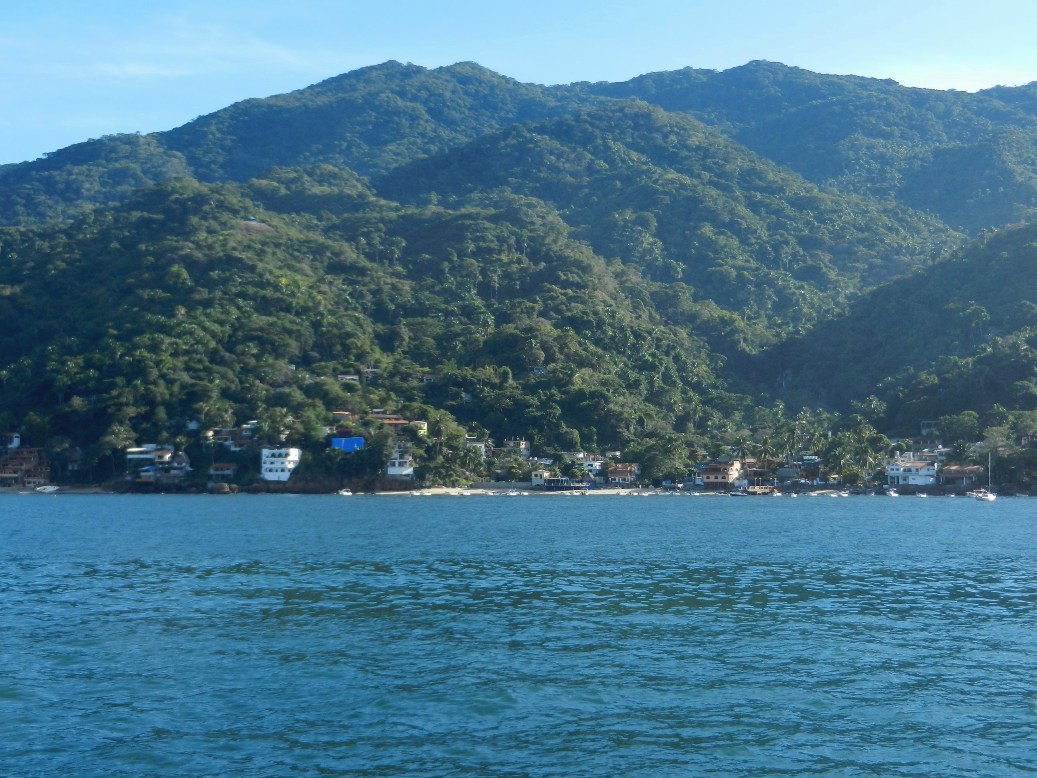
We departed Paradise Village Marina on January 10th in the afternoon, stopping at Puerto Vallarta for fuel before continuing our southbound journey.  With acceptable sea conditions and light wind, we headed for a cove on the southwest end of Banderas Bay to visit the unique village of Yelapa.  The cove at Yelapa is deep, has a narrow shelf, and is susceptible to ocean swell even on calm days so anchoring here is risky.  A sailboat which had been washed ashore in the not too distant past, lies stuck in the sand and serves as a somber reminder of the challenges.  Thankfully the village of Yelapa has installed a few buoys to entice boaters to visit.  As we entered the scenic cove, a panga came out to greet us and directed us to a buoy located near a rocky shoreline; we were assured that the buoy was sturdy and would hold our boat.  We tied on and watched for a while to confirm that we were being held in place.  After about 40 minutes, our panguero returned to take us into town.  Yelapa is indeed a charming and fascinating place to visit.  Surrounded by tropical rugged mountains, Yelapa can only be reached by boat or by horseback along a rough trail from Chacala.  The territory of Chacala and its neighboring villages, including Yelapa, was granted to the indigenous people by King Philip II of Spain in 1581.  The land is owned by the community collectively and the heritage of families living here goes back centuries.  Yelapa's sandy crescent beach is lined with palapa cafes and the village consists of narrow stone walkways winding around shops, cafes, and homes tucked in the hillside.  We headed for the cafe recommended by our panguero who led us along some narrow winding stairs.  After reaching the café near the community church, he introduced us to our waiter.  Our waiter had a great sense of humor, asking if we wanted to sit indoors (pointing to a covered patio) or if we wanted a window seat (pointing to a table overlooking the creek) - we chose the window seat.  As we sat enjoying the tropical setting, we saw three pack animals loaded with large timbers sauntering up the steep pathway near the cafe.  Perhaps the timbers would be used as forms for pouring concrete, the material of choice for homes built in Mexico.  Homes in Yelapa now have electricity which arrived for the village only recently in 2001!   After dinner we continued exploring the village and discovered more shops, cafes, and a well stocked grocery store.  Heading further up the hill, we entered the tropical forest, passing several quaint homes and guest houses. The trail was urging us on but the setting sun was fast approaching.  It was time to turn around and head back into town.  We were glad we had brought our headlamps, but would we find Richard, our panguero?  Sure enough he was waiting for us and directed us to the concrete pier for a ride back to our boat in the dark of night as lights from the village twinkled along the shoreline.


Our Cafe in the Tropics
Pathways Leading Through Yelapa
Pack Animal Loaded with Wood
A Donkey Dragging Large Timbers
Evening Time in Yelapa
Got D' Fever at Yelapa
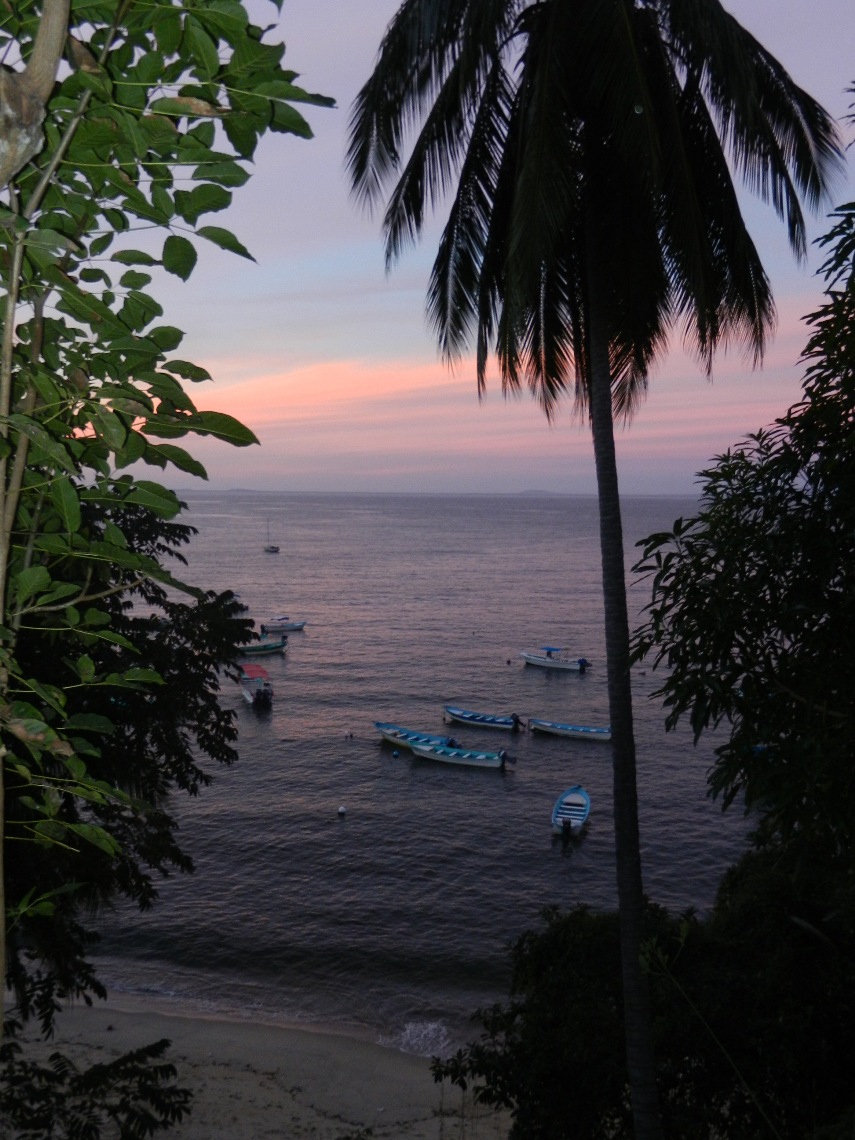
Sunset at Yelapa

Sunday, January 6, 2013

Paradise Found!


Java sporting her Red "Doggles"
Beach Palapas at Punta Mita

Relaxing at Punta Mita
This is The Life
It was back to blue sky and hot temperatures after the previous short rain spell.  The sun was so bright even Java needed her sunglasses for her daily walks.  One Sunday afternoon we decided to take a bus ride into the village of Punta Mita, located at the far northeast end of Banderas Bay.  This excursion involved an intermediate bus stop and transfer.  While waiting for our next bus, a local asked us where we were going and offered to point out the correct bus for us; perhaps we looked lost.  A short time later his bus arrived so he passed the information on to another local who took over the role of  Good Samaritan.  We are constantly amazed and overwhelmed by the kindness and good nature of the Mexican people; it almost brings tears to our eyes.  They live simple lives with big  hearts; it’s always a pleasure to be around these caring, loving people.  We can honestly say that not a single person has been discourteous or impatient, wow!  After getting on the right bus and thanking those who had helped us, we were on our way to Punta Mita speeding along a winding road above the ocean cliffs.  Having reached the last stop at a round-about, we got off the bus and walked into the small village of Punta Mita; what a gorgeous little spot!  The cove is lined with palm trees and adorable palapa cafes that overlook a white sandy beach and clear blue water; about a dozen boats were anchored a quarter mile off shore.  As we sat and enjoyed our lunch gazing out at the beautiful scenery, it reminded us of Hawaii - it's one of those “this is the life” kind of places.  We soon discovered that our waiter had lived for a number of years in the suburbs of Seattle including Kirkland; he had been in construction and drove heavy machinery.  It was great fun to have met him.  After lunch and a stroll on the beach, we caught the bus headed south and got off at the small town of Bucerias where we discovered a busy Sunday market.  Leonard found those leather sandals he had been looking for and also purchased a nice tailored white shirt.  Not to be outdone, I bought a shiny wooden bowl imprinted with the Aztec calendar, a perfect fruit bowl I contended.  Since the day was spent, pun intended, we grabbed a taxi for the ride home to Nuevo Vallarta.


Boy selling Elotes (cobs of corn) at Punta Mita
Sunday Market at Bucerias

Wednesday, January 2, 2013

Hilltop Discoveries


Intriguing Hilltop Avenues
Some Steep Wet Streets!
Steep Stairways

Pretty Garden Pathways


More Stairs to Climb
A Lovely Hilltop Home


The Hike Backdown
Homes Tucked along the Hillside
Today we wandered the hillside streets overlooking Puerto Vallarta.  We discovered some incredibly steep streets equaling those found in Seattle and San Francisco along with stairs and pathways that curve around homes with red-tiled roofs and pretty gardens.  It was a cloudy, rainy day so we came to appreciate all those stone streets that provide not only good traction for cars, but for foot traffic as well.  We happened upon an old lighthouse on the hill that operated from 1932 to 1978 and discovered a wonderful tapas restaurant.  The café is located four blocks up the hill from the malecon, a special find off the beaten path from the typical crowd of tourists.  The food was incredible, some of the best we’ve had!  Not long after we arrived, another couple came in and sat at a table next to us.  They asked how we found the place and we told them just by wondering around; they seemed very surprised!  The couple had eaten here once before and they were glad to have found it again claiming it was the best food in town.  As it turned out, they were from San Diego and had made many trips to Puerto Vallarta in connection with work.  They just recently purchased a home in one of the small coves of Banderas Bay for a more permanent residence.  He is a landscape architect and has spent ten years working in greater Puerto Vallarta.  Many U.S. citizens, some of which are now expats, work in Mexico providing their expertise and skills as well as many U.S. based companies.  The Mexican economy has recently been growing considerably faster than that of the U.S.  Interestingly, we've had several discussions with Mexican citizens who once lived and worked in the in the United States and have now returned to work in their homeland.  Quite a change from the 1930’s - in 1932 electrical service was very limited and Puerto Vallarta received its first plumbing system in 1939.  It wasn’t until 1942 that Puerto Vallarta was finally connected by road to the Sierra mining towns; until then the only access to Puerto Vallarta was by sea, air, or by mule trails from inland towns.  That same year, the New York based magazine Modern Mexico ran an advertisement to attract vacationers; by the 1950’s American tourists, mostly writers and artists in search of a retreat, visited the area.  Gringo Gulch began to develop as an expatriate neighborhood on the hill above Centro Puerto Vallarta.  It was in 1964 that Puerto Vallarta, then still a quiet fishing village, became famous thanks to the release of John Huston’s movie version of Tennessee Williams’ the Night of the Iguana staring Eva Gardner and Richard Burton; the film showcased beautiful Mismaloya Beach in Banderas Bay.  Richard Burton had brought his soon to be wife Elizabeth Taylor along with him, a noted love affair of the time.  Several years later the celebrities built homes at Gringo Gulch.
 

Esquina de los Caprichos -Best Tapas Cafe

Tuesday, January 1, 2013

Puerta Vallarta, a Highlight of Mexico


The Extensive Malecon - Puerta Vallarta
Friends Susan and Chris
Enjoying the shops and beach along the Malecon
Locals Enjoying Family Time
We shared a taxi with our friends Susan and Chris and spent an afternoon in the heart of downtown Puerta Vallarta; such a fun and exciting city!  The waterfront malecon includes numerous artistic sculptures, curved pathways, and foot bridges with easy access to the beaches and restaurants.  The well kept stone streets are full of interesting shops and cafes; one could spend hours exploring the city, a maze of narrow avenues with interesting discoveries around every corner!  White washed homes and condos tucked in the steep hillsides overlook the ships at sea.  Located near the waterfront is the Church of Our Lady of Guadalupe, the patron saint of Mexico and of Puerto Vallarta.  The lacy crown of the bell tower is a replication of the crown worn by Princess Carlota, wife of 19th century Maximilian, Emperor of Mexico (1863-67).  The bustle of activity, sights and sounds kept us so occupied that we lost all track of time.  We stopped for a late lunch and had a wonderful discussion with our like-minded friends who also enjoy traveling, boating, and life’s adventure of self-reliant independence.  Our taxi ride back to Nuevo Vallarta turned out to be an adventure in itself.  The traffic in the city was quite busy that day and our cab driver weaved between cars and trucks at a fast clip; I must admit he was very skillful and avoided the long backups with a known short cut.  Vendors who were selling fireworks came up to the taxi when we stopped at a light - Susan purchased two huge sparklers and the cab driver bought a serious looking firecracker.  Later that evening, the gang got together aboard Got D’Fever to share bringing in the New Year followed by a nice walk on the beach, a great opportunity to light those huge sparklers!  After a pleasant evening and goodnight wishes to friends, Leonard and I headed back to the boat and stayed awake until midnight, contributing to the noisy merry making.  We could see fireworks over the marina from our boat, blossoms of red and white lit the night sky.  Loud music was still playing at one of the local restaurants as we dozed off to sleep.  In the wee hours of the morning, I awoke to the sound of rain, a downpour on the docks and rooftops; the smell of fresh rain reminded us once again of home.  Perhaps the rain was washing away the old in preparation for a fresh start to a new year - Feliz ano Nuevo!  Happy New Year!

Many Streets and Hilltops to Explore

Well Kept Streets and Markets

The Crowned Bell Tower - Our Lady of Guadalupe


Church of Our Lady of Guadalupe